
Inclusion
Special Educational Needs
A child or young person has a Special Educational Need and/or Disability if they have a learning difficulty or disability which calls for special educational provision to be made for him/her.
According to the SEND Code of Practice (2015, p.16) a child or young person has a learning difficulty if they have:
- a significantly greater difficulty in learning than the majority of others of the same age, or
- has a disability which prevents or hinders him or her from making use of facilities of a kind generally provided for others of the same age in mainstream schools
SEND Information Report and Policy
- SEND Policy (hyperlinked to policy)
- SEND Information Report (hyperlinked to policy)
Areas of Need
- Communication and Interaction
- Cognition and Learning
- Social, Emotional and Mental Health
- Physical and/or Sensory
Communication and Interaction
A child or young person with Speech, Language and Communication Needs (SLCN) has difficulties using language and/or understanding language. They may also have difficulties with understanding the social rules of communication or find social interaction challenging, for example a child with Autism Spectrum Disorder (ASD).
Cognition and Learning
A child or young person with cognition and learning needs may learn at a slower pace than others their age. They may have difficulties accessing elements of the curriculum, or difficulties with organisational and memory skills. Learning difficulties include:
- Moderate Learning Difficulties (MLD)
- Severe Learning Difficulties (SLD)
- Profound and Multiple Learning Difficulties (PMLD)
- Specific Learning Difficulties (SpLD) such as dyslexia, dyspraxia, dyscalculia.
Social, Emotional and Mental Health
A child or young person with social, emotional or mental health needs may display a wide range of social and emotional difficulties. A child with such difficulties may appear withdrawn or isolated, display challenging or disturbing behaviours or have difficulties managing their emotions or their relationships. They may experience anxiety, depression, self-harm, substance misuse or eating disorders. A child or young person with Attention Deficit Disorder (ADD), Attention Deficit Hyperactivity Disorder (ADHD) or Attachment Disorder (AD) would also be included in this category.
Physical and/or Sensory
A child or young person who has a disability may have:
- a visual impairment (VI)
- a hearing impairment (HI)
- a physical difficulty (PD)
- multi-sensory impairment (MSI)
This means they might need extra support or specialist equipment to access the curriculum or school life.
At APWG, we work collaboratively with a range of external agencies to ensure that we provide appropriate support for our children with special educational needs. Please see further information below by clicking on each of the agency icons.
Agency Support
- Speech and Language Therapy
- Occupational Therapy
- Physiotherapy
- CAMHS
- Inclusion Support
- School Nurse Team
- Helping Hands
Speech and Language Therapy
As a parent, you can make a referral to the Speech and Language Therapy Team if you have concerns regarding your child's:
- speech development,
- language development,
- pronunciation of sounds or words,
- social understanding or social interaction,
- stammering,
- feeding or swallowing ability.
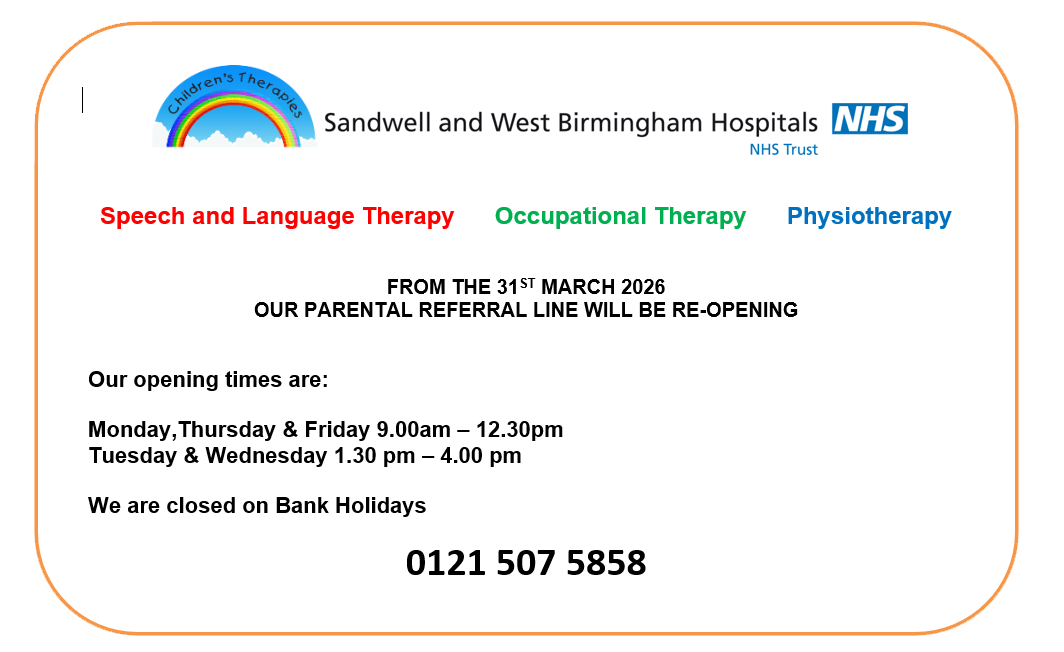
Referrals can be made by contacting the Faster Access to Sandwell Therapy Assessment (FASTA) line using the telephone number below or the referral form
Speech and Language Parent Referral Form
For further information, please click the following link:
Occupational Therapy
Sandwell's Occupational Therapy Team provide support to children who have a physical disability which affects participation in everyday activities. Support will be provided under the following headings:
- self-care,
- leisure and play,
- school work productivity.
Referrals can be made, by parents, by contacting the Faster Access to Sandwell Therapy Assessment (FASTA) line using the telephone number below.
For further information, please click the following link:
Physiotherapy
As a parent, you can make a referral to the Physiotherapy Team if you have concerns regarding your child's:
- mobility,
- muscle weakness,
- balance,
- development.
Referrals can be made by contacting the Faster Access to Sandwell Therapy Assessment (FASTA) line using the telephone number below.
SENCO/Inclusion Managers
- Albert Pritchard Infant School: Miss Carter
- Wood Green Junior School: Miss Johnson